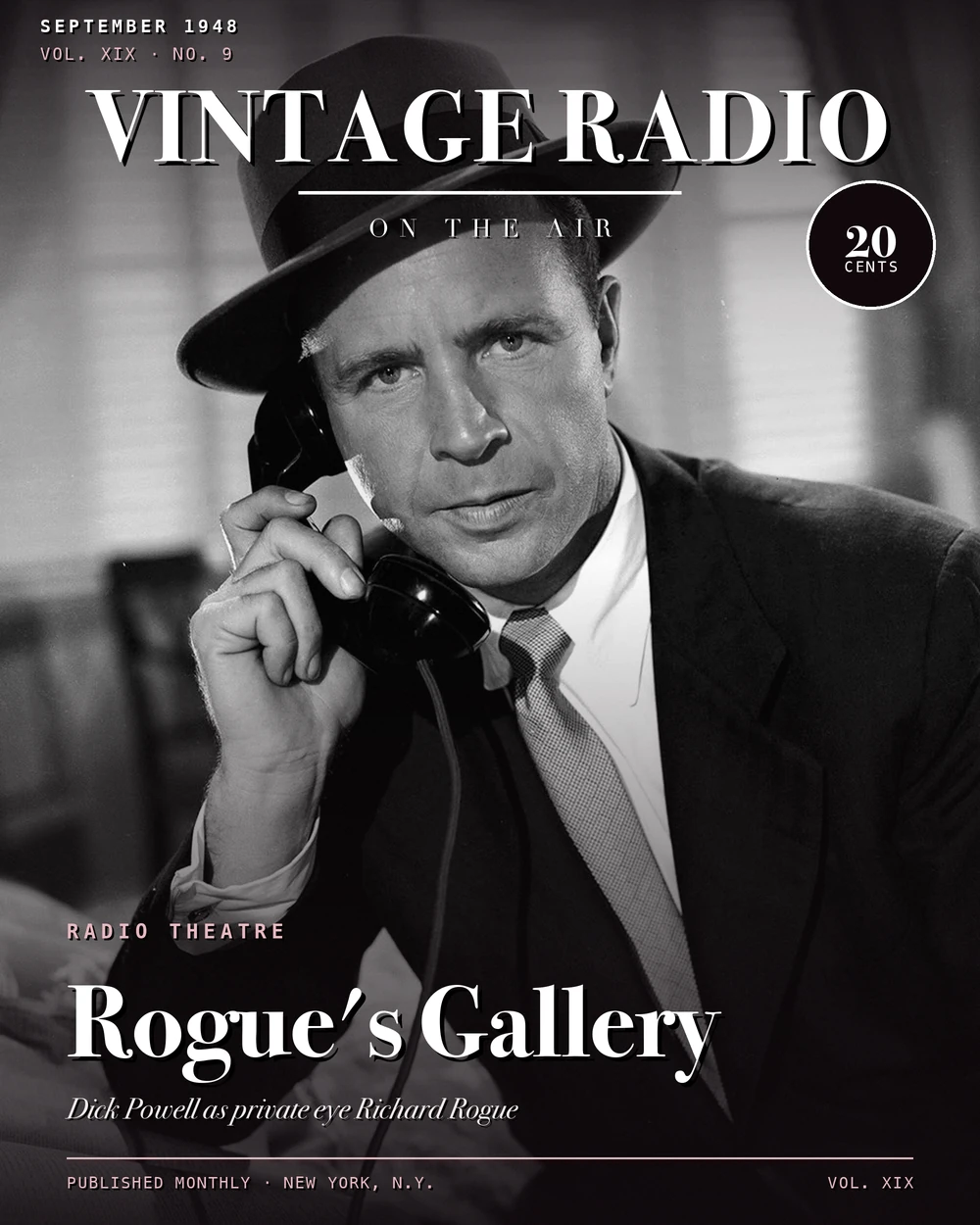
Rogue's Gallery
The Show and Its Gimmick
Rogue's Gallery debuted on NBC in the summer of 1945, landing in a slot vacated by The Fitch Bandwagon, where it ran under the title Bandwagon Mysteries and returned to fill that same summer hole in 1946 and 1947. Between those NBC stints, it moved to Mutual for a full season. At its core it was a Crime-Detective show built around Richard Rogue, a first-person narrator in the hard-boiled mold — a private eye who trailed blondes and protected witnesses, voiced in the tough-guy register that the era's audiences were beginning to expect from the genre.
The title was a deliberate double pun: it played on the protagonist's surname and on the term "rogues' gallery," meaning a collection of photographs of known criminals. That same wit ran through the show's central device — Eugor, Rogue's alter ego, whose name is simply "Rogue" spelled backward. Eugor appeared only when Rogue had been knocked unconscious or fed knockout drops, materializing in a dreamlike state the show called "Cloud Number Eight." There, described as cackling like the host of The Hermit's Cave, Eugor would berate Rogue about whatever clue or piece of business he was in danger of missing, then boot him off the cloud and back into consciousness with a vague but useful idea of what to do next. It was a gremlin version of inner monologue, inserted mid-story to mechanically advance the detective's reasoning while keeping the first-person narrative intact.
Dick Powell's Transition
The show's most significant function in radio history may have been what it did for Dick Powell's career. Powell had spent the early 1930s as a singing juvenile lead at Warner Bros., the kind of light musical talent that studios packaged in big-budget revues. The image stuck. When RKO cast him as Philip Marlowe in the 1944 noir Murder, My Sweet, the studio initially retitled the film from Farewell, My Lovely specifically because audiences were expected to assume any Dick Powell picture was a musical. Director Edward Dmytryk was openly skeptical, later saying "the idea of the man who had sung Tiptoe Through the Tulips playing a tough private eye was beyond our imaginations." The film opened in New York on March 8, 1945, made roughly $597,000 in profit, and permanently reset Powell's screen image.
Rogue's Gallery arrived just three months later, in June 1945, and served the same purpose in radio that Murder, My Sweet had served in film — a vehicle for Powell to be recognized as an actor rather than a singer. His Richard Rogue was a working private eye with a quick tongue. Powell left the franchise after the second NBC summer run in 1946 to focus on films, but the groundwork he laid here fed directly into Richard Diamond, Private Detective, which debuted in 1949 and became one of the most popular private-eye shows on network radio. He later produced the television version through Four Star Productions, the company he co-founded, which also produced The Zane Grey Theater, Burke's Law, and Dick Powell Theater.
The Actors Who Played Rogue
Three other actors held the role across the show's run. Barry Sullivan took over for the 1947 NBC summer run — a 14-week stint that surviving recordings suggest was a noticeably different reading. One listener described Sullivan's audition episode as sounding "almost like a parody of a hard-boiled detective," characterizing it as "a cross between Jimmy Cagney and Jack Webb." Sullivan went on to a long film career that included Tom Buchanan in The Great Gatsby (1949) and a prominent supporting role in The Bad and the Beautiful (1952).
Chester Morris and Paul Stewart shared the ABC run from late 1950 through November 1951, which aired Wednesdays at 9 on a sustaining basis with no commercial sponsor. Morris was best known at that point for playing Boston Blackie across 14 Columbia Pictures films between 1941 and 1949, a role he had also reprised on radio in 1944; he'd received an Academy Award nomination for Best Actor for Alibi back in 1929. Stewart's background was just as substantial — a Mercury Theatre alumnus who played Raymond the butler in Citizen Kane (1941), served as rehearsal director and co-writer on the 1938 War of the Worlds broadcast, and held AFRA membership card number 39 from the union's founding in August 1937. Stewart ultimately played Richard Rogue more times than any other actor: approximately 72 programs to Powell's approximately 67. Despite that, Stewart is the least-represented in surviving recordings — almost everything that circulates today comes from the Powell era.
What Survives
The Mutual run, produced by Dee Engelbach and written by Ray Buffum — who also wrote the 1947 NBC season — with Leith Stevens leading the orchestra, is where most of the surviving material lives. Episode titles from that run include "Murder in Drawing Room A," "Little Old Lady," "Fortune in Furs," and "Anson Leeds Is Dead," among others. One episode from the Sullivan NBC run, "Phyllis Adrian Is Missing" from June 1947, has also been catalogued. The supporting cast on Mutual included Lou Merrill, Gloria Blondell, Gerald Mohr, Tony Barrett, Ted von Eltz, and Lurene Tuttle — a roster of working Hollywood radio actors. Peter Leeds played Eugor throughout the Mutual run, voicing the alter ego's goading appearances on Cloud Number Eight with what one description characterized as an echo-chamber quality reminiscent of Arnold Stang.
Rogue's Gallery is sometimes cited as one of the first hard-boiled private-eye shows to arrive on American radio — a genre that would define so much of crime radio in the late 1940s was largely absent from the medium before the summer of 1945. The show carried the seeds of what Powell and Buffum would refine into Richard Diamond four years on: the wisecracking first-person detective, the female entanglements, the comic counterpoint to genuine danger. The Eugor device didn't make the trip — Richard Diamond dropped the alter ego — but the tone and the template did.